Understanding the Role of Process Control Systems in Manufacturing Plants

You use process control systems to manage hard jobs in a manufacturing plant. These systems help keep things working well and safe. Basic automation only does easy jobs. Process control systems do much more. Think about driving a car with cruise control. Now, think about the car changing speed and direction by itself. You do not have to do anything. In manufacturing, real-time monitoring helps you find problems fast. You can fix things quickly. Most plants use process control systems more than basic automation.
System Type | Utilization Rate |
|---|---|
Process Control Systems | |
Basic Automation Systems | Around 60% |
When you use real-time monitoring, reject rates go down from 30% to 2%. Production schedules can change to meet new needs. Remote access helps keep your plant safe and working. You may wonder how these systems work. You may also wonder why they are important in Manufacturing Process Control.
What Is Industrial Process Control?
Definition and Main Goal
You see industrial process control in many manufacturing plants. It helps you manage and watch every step of making products. This system uses sensors and devices to check things like temperature, pressure, and flow. It keeps these things steady automatically. You don’t have to watch everything yourself. The system uses feedback loops to respond to changes. If something goes wrong, it fixes it quickly. This leads to better quality and less waste. Industrial process control works in different ways. You find control systems for batch production. Continuous process control is used in chemical plants. Batch control systems follow recipes. Advanced methods like feedback, feedforward, cascade, and ratio control make the system more accurate. You rely on industrial process control to keep your plant running smoothly.
Industrial process control gives you real-time data. You can find problems early and act fast.
How It Differs from Basic Automation
Industrial process control does much more than simple automation. Basic automation handles easy tasks. It starts or stops machines. Industrial process control manages complex tasks. It checks many variables at once. It makes automatic adjustments without needing manual work. It uses smart algorithms that learn from data. Over time, it gets better. Basic automation can’t do this. You need industrial process control for safety and efficiency. It reduces mistakes and keeps your plant safe. It also connects with other systems like ERP or MES. Basic automation doesn’t offer this level of connection. Industrial process control gives you more flexibility. You can change production plans and adapt to new needs. Basic automation stays fixed. You depend on industrial process control to meet modern manufacturing needs.
Feature | Basic Automation | Industrial Process Control |
|---|---|---|
Task Complexity | Simple | Complex |
Real-Time Adjustment | No | Yes |
Connection with Other Systems | Limited | Wide |
Safety and Quality | Moderate | High |
You see that industrial process control is very important for all manufacturing plants. It helps you reach your goals and keeps your operations safe.
Key Components of Process Control Systems
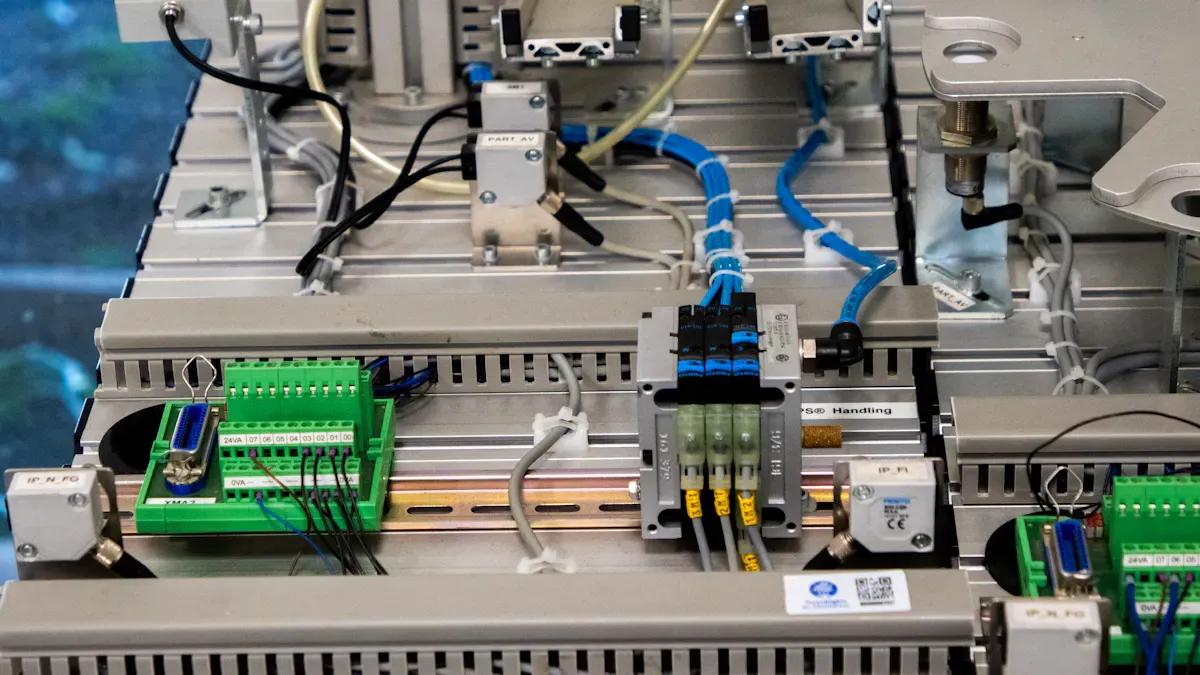
Process control systems use hardware and software to help plants work well. These systems watch and control each step with special tools and feedback. Every part has a job to make sure things are safe and correct.
Sensors and Measurement Devices
Sensors and measurement devices are like the plant’s eyes and ears. They gather real-time data about things like temperature and pressure. They also check flow and gas levels. Level sensors tell you how full tanks or containers are. This helps keep things safe and running well. Flow sensors watch how fast liquids and gases move. This stops spills and helps machines work by themselves. Gas sensors find dangerous or flammable gases. This keeps workers safe. You use these tools to give feedback to the system. Feedback is important for making quick changes.
Sensor Type | Description |
|---|---|
Pressure Sensors | Watch pressure in systems to make things safer and better. |
Flow Sensors | Check flow rates, help processes, and stop spills. |
Gas Sensors | Find dangerous gases to keep people safe and follow rules. |
Level Sensors | Measure how full tanks are and give feedback for control. |
Controllers and Algorithms
Controllers and algorithms are like the brain of the system. They look at sensor data and compare it to setpoints. Then they make changes right away. PID controllers use three parts: Proportional, Integral, and Derivative. The proportional part fixes problems right now. The integral part looks at old data to fix leftover mistakes. The derivative part guesses what will happen next. This helps you act fast. You can change these parts to get the best results. Feedback loops let the system watch and change things all the time. This makes the plant more stable, safer, and wastes less. You need feedback to keep things working well.
Actuators and Final Control Elements
Actuators and final control elements do what the controllers decide. You see them as control valves, dampers, or speed drives. These parts change how fluids move, air flows, or motors run. When the system sends a signal, actuators move to change things. For example, a control valve can open or close to change temperature or pressure. It can also change liquid levels. You count on these parts to follow feedback and keep things working right.
Human-Machine Interface (HMI)
The Human-Machine Interface, or HMI, lets you talk to the system. You use HMIs to see data, watch machines, and make changes. HMIs can show you old data to help you decide what to do. You can use HMIs on screens, computers, or phones. Some HMIs let you check your plant from far away. This helps you keep your plant safe and working well.
Functionality | Description |
|---|---|
Real-time data visualization | Shows you data right away so you can watch things. |
Equipment monitoring | Lets you see how machines work and control them. |
Historical data access | Lets you look at old data to make better choices. |
Remote access | Lets you control things from other places. |
You can see how sensors, controllers, actuators, and HMIs all work together. They use feedback and feedback loops to keep your plant safe and running well.
Types of Manufacturing Process Control Systems
Open-Loop vs. Closed-Loop Control
There are two main types of control systems. Open-loop systems do not use feedback. You set controls, and the system follows your instructions. It does not check if the result is right. Closed-loop systems use feedback to make changes. They watch what happens and adjust to keep things steady. Closed-loop systems help keep things accurate.
Feature | Open-Loop Control System | Closed-Loop Control System |
|---|---|---|
Feedback | No feedback taken from processes | Uses feedback to optimize processes |
Simplicity | Simple in construction and design | More complex due to feedback mechanisms |
Cost | Inexpensive to implement and maintain | Generally more expensive due to software and training |
Reliability | Poor reliability, cannot adapt to uncertainties | Reliable and accurate due to feedback |
Flexibility | Lacks flexibility to self-correct | Flexible and can recover quickly from disruptions |
Accuracy | Poor accuracy without feedback | High accuracy reflecting actual production state |
Closed-loop systems help keep your plant safe. Open-loop systems work best for simple jobs.
Distributed Control Systems (DCS)
You use Distributed Control Systems in big plants. DCS helps manage complex processes. It controls things like temperature and flow rate. DCS uses many controllers all over the plant. It reduces waste and makes things safer. You see advanced screens that show what is happening. DCS helps you keep everything running smoothly.
DCS manages important variables to keep things stable.
It improves safety and throughput by adjusting in real time.
The system uses distributed processing for reliability.
Programmable Logic Controllers (PLC)
You find PLCs in many industries. PLCs automate production and control machines. They help increase efficiency and precision. PLCs manage complex workflows. You can add PLCs to your plant. They work in automotive, pharmaceuticals, food, and energy plants.
Automate production processes
Control machines and manage workflows
Ensure precision and efficiency
Integrate with other systems
Supervisory Control and Data Acquisition (SCADA)
SCADA lets you monitor and control your plant from far away. You collect data from sensors and see it on your screen. SCADA makes automatic decisions and sends alerts when needed. You get reports to track performance and make smart choices.
Remote access speeds up monitoring
Data collection helps you make better decisions
Automation reduces manual work
Alerts protect workers and equipment
Reports show how your plant is doing
SCADA gives you more flexibility and safety. You can spot problems early and keep your plant running well.
How Process Control Systems Work in Manufacturing
The Control Loop Explained
You see process control systems at work every day in manufacturing plants. These systems use a control loop to keep everything running smoothly. The control loop acts like a smart helper. It watches the process, makes decisions, and takes action to keep things steady.
A typical control loop in process control systems follows these steps:
You collect historical data from the process. This includes information about what you changed and what happened next.
The system uses this data to predict what will happen if you make certain changes. It uses models to guess the best way to reach your goal.
The controller applies the changes it calculated. It then checks the results and uses feedback to see if things improved.
You can think of the control loop as a cycle that never stops. The controller always looks for ways to keep the process on track. It uses negative feedback to fix problems. If the temperature gets too high, the controller lowers it. If the pressure drops, the controller brings it back up. This keeps the process safe and stable.
Sometimes, you need more than one controller. Cascading controllers help when you have a complex process. One controller sets the goal for another. This way, you can manage different parts of the process at the same time.
Tip: The control loop helps you catch problems early. You can fix issues before they become big troubles.
Real-Time Monitoring and Adjustment
Process control systems give you real-time monitoring. You see what is happening in the process right now. This helps you make quick decisions. If something changes, you can act fast. The system shows you data on screens or even on your phone. You do not need to wait for reports.
Let’s look at a chemical plant as an example. In this plant, process control systems watch every step. They check the temperature, pressure, and flow. If the process starts to drift, the system makes changes right away. You do not need to step in. The system uses advanced technology, like AI and machine learning, to keep everything working well. This keeps the product quality high and the process efficient.
You also use process control systems in bottling plants. Here, the system checks the speed of the conveyor, the fill level in each bottle, and the cap placement. If a bottle is not filled right, the system stops the line and fixes the problem. This reduces waste and keeps the process moving.
Process control systems help you:
Keep the process steady and safe.
Reduce waste and save money.
Improve product quality.
Respond quickly to changes.
You rely on process control systems to watch, control, and adjust the process every second. Real-time monitoring means you always know what is happening. You can trust the system to make the right changes. This gives you peace of mind and helps your plant run better.
Note: Real-time monitoring and fast adjustment are key reasons why process control systems are so important in modern manufacturing.
Benefits for Process Manufacturing Plants
Efficiency and Productivity
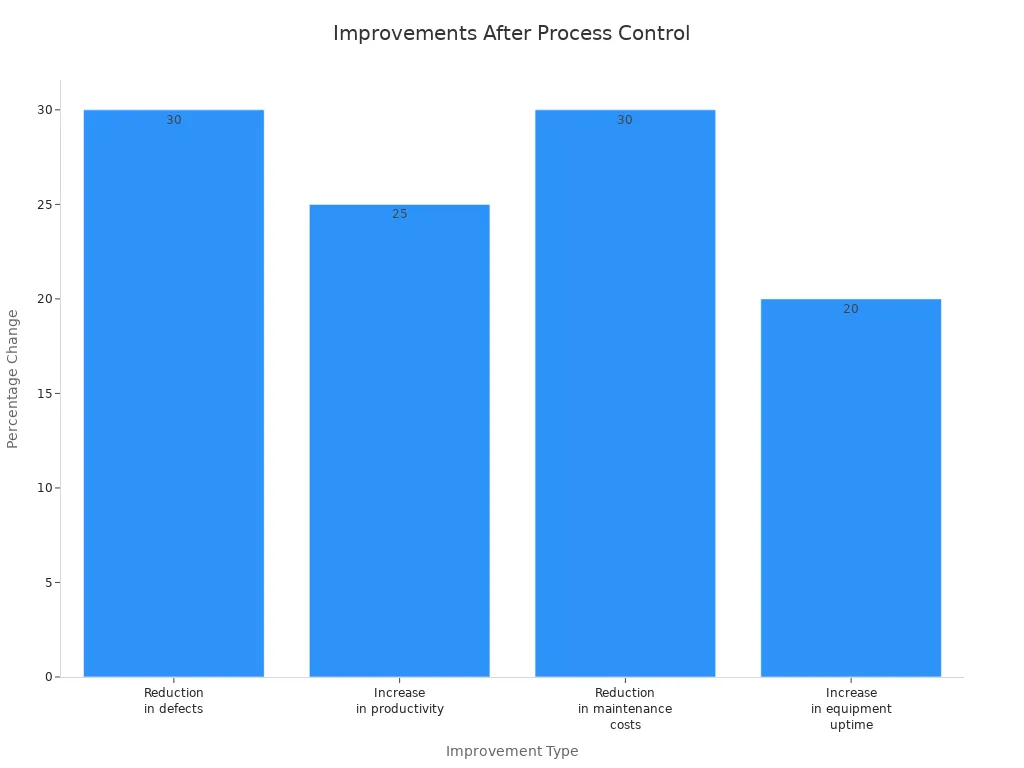
Process control systems make plants work better and faster. They help you make fewer mistakes and save money on repairs. Machines break down less often. You can see the gains in the table below:
Improvement Type | Percentage Change |
|---|---|
Reduction in defects | |
Increase in productivity | 25% |
Reduction in maintenance costs | 30% |
Increase in equipment uptime | 20% |
You can use machines to do jobs by themselves. This makes products more exact and faster to make. Companies can make more things in less time. This means they spend less money. Advanced process control also saves energy and helps you get more from your plant.
Quality and Consistency
Process control systems help you keep quality high. You can watch every step as it happens. You find problems fast and fix them right away. Checking quality all the time helps you get better. Digital tools help you meet food safety and quality rules. You can use data to see patterns and make sure products are always good.
Watching all the time helps you find problems early and keep products safe.
Safety and Risk Reduction
Process control systems keep workers and machines safe. They help you lower risks and stop accidents. You can use special methods, like the Bow-Tie approach, to make things safer by over 22%. Real-time alerts warn you about danger. You can act fast to protect everyone. You also have fewer accidents and machine problems. Safety stays strong because you always watch and control the process.
Cost and Resource Optimization
Process control systems help you save money and use less stuff. You make more good products with fewer materials. There are fewer mistakes and less time when machines stop. Workers do not have to do boring jobs as much. You follow rules better and get more done. Automation keeps quality high and costs low. AI and digital twins help you find problems without stopping work. You use machines and people in the best way.
Process control systems help you act fast and waste less.
Integration with Manufacturing Systems
ERP and MES Connections
Process control systems work best when they connect with other tools. ERP and MES help you manage orders and production. When you link process control systems with ERP and MES, you get many benefits:
You see data right away.
You do less manual work.
You make better decisions.
You can watch how your plant is doing in every department. Closed-loop quality management lets you fix problems fast. Smarter scheduling helps you use machines and workers well. Plantwide performance visibility gives you a clear view of what is happening.
You face some challenges when connecting these systems. You need to match data between ERP, MES, and process control systems. Handling lots of information can be tough. Good communication between IT and OT is important. You must make sure all parts work together without mistakes.
Industrial automation makes these connections stronger. You can automate tasks and share information quickly. This helps your plant run smoothly and safely.
Industrial Internet of Things (IIoT)
Industrial Internet of Things, or IIoT, changes how you use process control systems. IIoT connects sensors, machines, and computers. You get real-time monitoring and predictive analytics. This helps you improve asset performance and work more efficiently.
Here is how IIoT helps your plant:
Improvement Area | Percentage Improvement |
|---|---|
Lower maintenance costs | |
Better asset utilization | 20-35% |
Less unplanned downtime | Up to 40% |
You lower risk with better visibility and control. Automated monitoring and reporting help you follow rules. Digital operations give you an advantage.
Modern IIoT systems work well with your control systems. You see easy integration with PLC and SCADA. Real-time two-way communication lets you adjust control loops and make changes. You use industrial automation to keep your plant flexible and ready for new challenges.
Tip: IIoT helps you find problems early and act fast. You keep your plant safe and efficient.
Best Practices for Implementation
Assessing Plant Needs
First, you look at what your plant needs. You check your systems to find ways to improve. You ask about your goals for production, safety, and quality. You see how your systems affect how well things work. You talk with your team and get their feedback. You use data to find weak spots in your systems. You set clear goals for quality and performance. You make a list of what your plant must do. You focus on systems that help you reach these goals.
System Selection
You pick systems that match your plant’s needs. You compare different systems to see which ones fit your quality standards. You look for systems that help your plant work better. You check if the systems connect with ERP and MES. You choose systems with real-time monitoring and adjustment. You make sure the systems help you follow safety and quality rules. You select systems that are easy to use and keep up. You ask vendors about support and training. You test the systems before making your choice.
Criteria | What to Look For |
|---|---|
Compatibility | Works with current systems |
Quality Support | Meets quality standards |
Performance Boost | Improves plant performance |
Safety Features | Protects workers and equipment |
Ease of Use | Simple for staff to operate |
Training and Change Management
You train your staff to use new systems. You give ongoing training so everyone stays up to date. You involve your team and explain changes clearly. You listen to worries and show the benefits. You include important people in the process. You show how the systems make quality and performance better. You use hands-on practice and digital tools. You make sure everyone feels good about using the systems.
Ongoing training keeps your team ready.
Involving your team builds support.
Listening to worries helps smooth changes.
Tip: Get your team involved early. This helps everyone accept new systems and improves performance.
Maintenance and Improvement
You keep your systems working with regular maintenance. You make a checklist for your equipment. You inspect and write down the condition of your systems. You use digital tools to track maintenance jobs. You connect maintenance with production, quality, and safety. You use platforms like CMMS to move from fixing problems to preventing them. You check if your systems follow safety and quality rules. You update your systems to make them work better. You review data and make changes to keep your systems efficient.
Make a maintenance checklist for your systems.
Inspect and write down important systems often.
Use digital platforms to make maintenance easier.
Note: Maintenance keeps systems stable and helps quality and performance stay high.
Process control systems are very important in manufacturing. They help you run production and check quality. They also keep workers and machines safe. You use these systems to gather data and plan work. They help you control resources in the plant. If you learn about process control, your plant works better. You can lower risks and problems. Here are steps to help you get better at manufacturing:
Look at your control methods and make them better.
Get ready to connect your systems together.
Make safety and data collection your main focus.
Manufacturing will use smart technology, IoT, and digital twins soon. Plants will earn more money, waste less, and be safer as things change.
FAQ
What is the main purpose of process control systems in manufacturing?
Process control systems help your plant run well. They help you manage each step in making products. These systems make sure products are good quality. They also help you waste less and keep everyone safe.
How does automated control improve plant operations?
Automated control lets machines make changes fast. You do not need to do everything by hand. This helps stop mistakes and keeps machines working well. You can spend more time on other important jobs.
What are the key benefits of industrial process control?
Industrial process control gives you better quality and safety. You waste less and save money. Your plant works faster and costs go down. These systems make your plant more reliable and efficient.
How does remote monitoring help you manage your plant?
Remote monitoring lets you check your plant from anywhere. You can find problems early and fix them quickly. Your plant stays safe and keeps working, even when you are not there.
How do process control systems optimize performance?
Process control systems adjust machines right away. This helps you use your equipment and resources better. You get more done and see better results every day.
See Also
Understanding SPC: Enhancing Production Through Statistical Process Control
Simplifying Manufacturing: Comparing Constraint Theory and Six Sigma
A Comparison of Discrete and Process Manufacturing Techniques
The Importance of Fool-Proofing in Today's Manufacturing Industry
Exploring QFD, FMEA, and DOE's Impact on Manufacturing Quality
About Hunan Puka

Established in 2016 and based in Hunan, China, with a liaison point in Berlin, we are a Tier 2 supplier for the automobile industry. We specialize in the production of customized aluminum die-casting parts designed for machines with a closing force ranging from 280 to 1250 tons, with subsequent manufacturing process CNC machining and surface treatment. Our commitment to quality is reflected in our accredited quality management system, certified by ISO9001:2015 and IATF16949:2016 standards.